My research lies in Robot Learning, with the long-term goal of developing
robotic systems that can learn from diverse experiences and progressively achieve
more capable and autonomous behavior. My research is driven by two questions:
Experience → Capabilities: How can robots acquire generalizable
capabilities from diverse experiences, ranging from robot data across embodiments to
human demonstrations?
Selected work:
FoveaVLA,
τ0-VLA
Capabilities → Autonomy: How can robots leverage learned capabilities
to accomplish increasingly complex, long-horizon tasks through reasoning and interaction?
Selected work:
Astra-on-RoboMME,
τ0-VLA
I am currently seeking a Ph.D. position starting in Fall 2027, and I am
always happy to chat about research fit or potential collaborations.
Feel free to reach out!
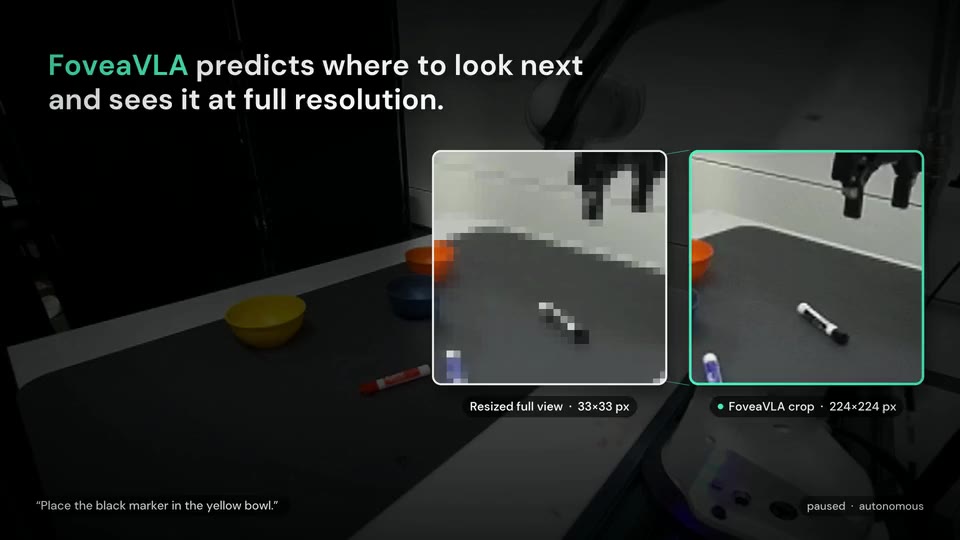
A vision-language-action model that replaces the wrist camera with a learned
foveation action: alongside each action chunk, it predicts the region it will
need to see next and crops it from the original-resolution external image.
Trained only on public DROID data, with no camera calibration, it raises
real-world success from 52.1% (π0.5 with a wrist camera) to
70.8% with one external camera and 77.1% with two.
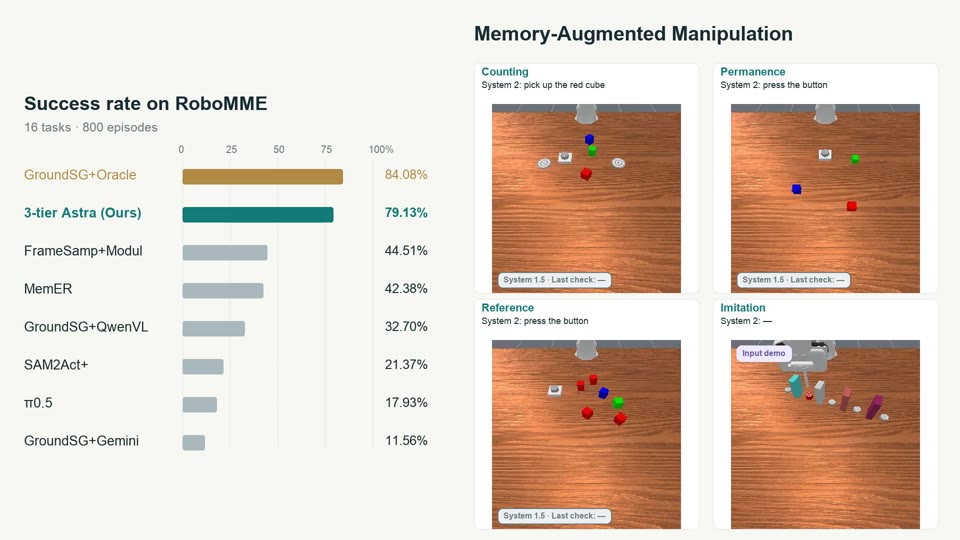
A three-tier system for memory-augmented manipulation: GPT-6 Astra plans
grounded subtasks, a fine-tuned π0.5 executes them, and a small
fine-tuned VLM monitors subtask completion to decide when to call Astra again.
On 800 RoboMME test episodes, it reaches 79.13% success with only 3.63 Astra
calls per episode, close to the 84.08% oracle-guided upper bound.
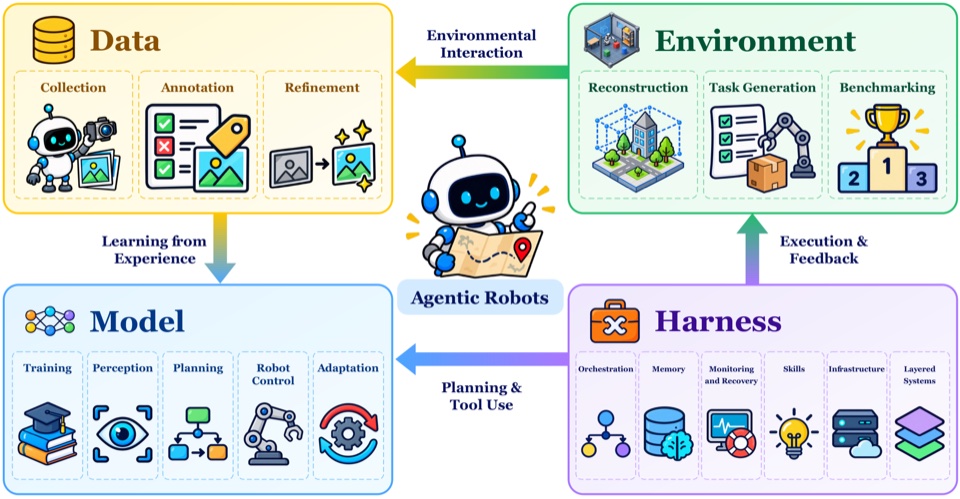
A survey of agentic robots: systems that reason over instructions, interact
with their environment, and correct their own execution errors. It traces the
path from task-specific policies through VLA models, world models, and
world-action models, then organizes the field into seventeen categories across
four domains: Model, Data, Environment, and Harness.
A hierarchical robot foundation model that treats high-level subtask
generation as a compute-scalable inference problem: it proposes candidate
subtasks, predicts their outcomes with a world model, and searches over them
before committing. Trained on 40,115 hours of real-world data, it improves
success on long-horizon manipulation tasks.